
Cyber Security Awareness Poster
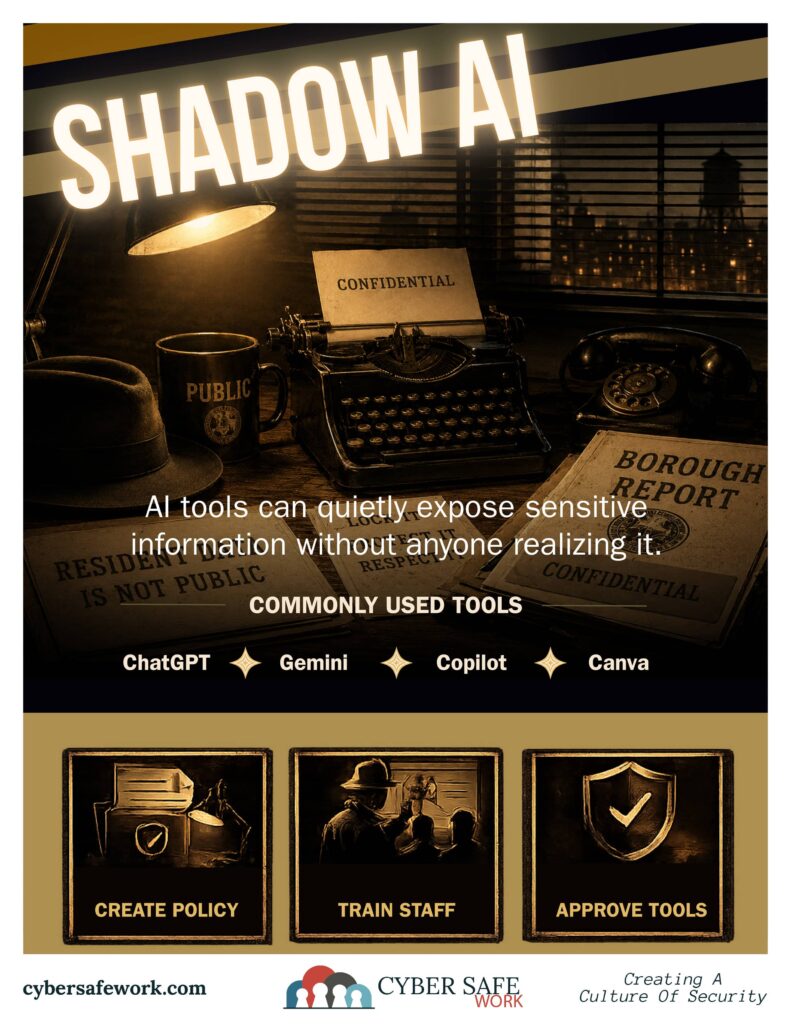
Your Data Is Not Public: Protecting Sensitive Information While Embracing AI
Artificial intelligence makes drafting emails, summarizing documents, analyzing information, and completing everyday tasks faster than ever. With various tools easily accessible, employees are adopting them quickly and often before organizations have had time to formulate policy.
That creates a simple but important cybersecurity problem: not everything you have access to is information you have permission to share.
Customer records, employee information, account numbers, internal documents, financial records, passwords, contracts, and other confidential information can all become security risks when they are copied into an AI tool without understanding where that information goes or how it may be used.
The challenge is not necessarily stopping employees from using AI. As The Hacker News notes, organizations need practical safeguards that allow people to use these tools without creating an unnecessary opportunity for a data breach.
AI Tools Need Data
AI tools work because we give them information. But not all data is the same. Asking an AI tool to rewrite a generic sentence is very different from uploading a spreadsheet containing customer names, addresses, account information, or employee records.
Establishing boundaries around what information employees may share and how that information may be handled is key in protecting an organization from inadvertently sharing sensitive information.
Before entering business information into any AI platform, employees should consider a few basic questions:
- Does this contain personal or confidential information?
- Does the AI provider retain what I enter?
- Can the information be used to train the provider’s models?
- Who else may have access to the information?
- Has my organization approved this tool for this type of data?
If you do not know the answers, confidential information should stay out.
Not All AI Tools Carry the Same Risk
One of the easiest mistakes organizations can make is treating every AI product as though it works the same way.
It does not.
An AI writing assistant that helps correct grammar may have access to very different information than an AI application connected directly to your email, cloud storage, accounting software, or customer relationship management system.
When evaluating an AI product, organizations should consider the vendor, its security history, how it handles submitted data, its compliance practices, and what other systems the application can access. This type of contextual risk assessment shows that the risk depends heavily on what the application can see and do.
That also means employees should not assume that a tool is safe simply because it is popular, free, or built into software the organization already uses.
Access Does Not Mean Permission
Cybersecurity policies frequently focus on preventing outsiders from accessing information. AI introduces another concern: what authorized employees do with information after they access it.
An employee may legitimately have access to a customer database, personnel file, financial report, or confidential document. That does not automatically mean the information can be copied into an outside AI service.
Organizations should establish clear rules identifying which tools employees may use, what information can be entered into those tools, and whether certain applications or integrations are prohibited.
AI Security Is Not a One-Time Decision
Anyone online knows that technology is an everchanging landscape. Approving an AI application today does not mean it will carry exactly the same risk next year.
Software changes. Vendors introduce new features. Permissions expand. Applications begin connecting with additional services. Employees also discover new ways to use the technology. For this reason, an organization’s cybersecurity policy should be reviewed annually. As a matter of fact, public companies must report their cybersecurity analysis to the SEC annually. Your board of directors or council might require something similar even if your insurance company does not.
Being an ever-growing part of our technical repertoire, AI security needs ongoing review. Organizations should assess AI tools being used, what information employees are sharing with them, and whether those tools still meet the organization’s security standards; monitor changes in permissions and data flows; review vendor updates; and audit AI use over time. This can be a lot without professional help, and having a trusted IT professional in your corner can certainly help.
Lock It. Protect It. Respect It.
Most employees are not intentionally putting company information at risk. The problem is that AI makes sharing information extremely easy. Copy, paste, upload, and suddenly data that once existed only inside your organization has been submitted to another system.
A few seconds of consideration can prevent a much larger problem.
Treat personal, customer, employee, financial, and confidential business information as exactly what it is: private data entrusted to your organization.
Use approved tools. Follow your organization’s policies. Remove sensitive information when it is not necessary. And when you are unsure whether something should be shared with an AI application, ask before you upload it.
AI can be an incredibly useful business tool. Safe adoption does not require saying no to AI altogether.
CourseVector grants permission to use this artwork for any non-commercial purpose as long as the CourseVector contact information remains, as is, on any reproduction or use.
