
Cyber Security Awareness Poster
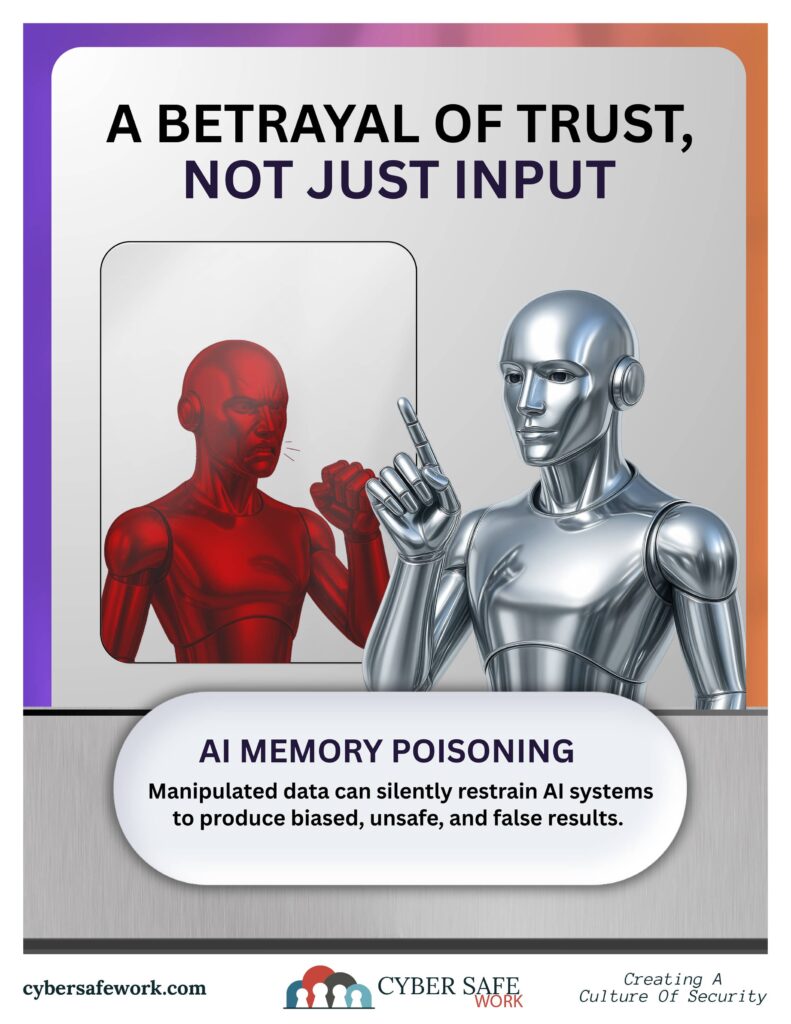
AI Memory Poisoning: When AI Learns the Wrong Lessons
Artificial intelligence tools are becoming part of everyday work. Employees use them to draft emails, summarize documents, answer questions, and help make decisions. Many of these tools are designed to remember information over time so they can provide more personalized and useful responses. But what happens when the information being remembered is incorrect, misleading, or intentionally manipulated?
This growing concern is known as AI memory poisoning.
AI memory poisoning occurs when false, harmful, or misleading information is introduced into an AI system’s memory or knowledge base. Over time, the AI may begin relying on that information when generating responses, making recommendations, or assisting users. The result can be biased answers, inaccurate information, unsafe recommendations, or decisions based on faulty assumptions.
How AI Memory Poisoning Works
Many people think of AI as a tool that simply answers questions based on its original training. Increasingly, however, AI systems can retain information from previous conversations, learn from organizational documents, or reference data stored in connected systems.
If inaccurate information enters that memory, the AI may begin treating it as fact.
For example, imagine an employee uploads a document containing outdated procedures. Another employee later asks the AI how to handle a particular task. If the AI references the outdated document, it may provide incorrect guidance. The problem becomes even more serious if someone intentionally inserts false information designed to influence future responses.
Unlike traditional cyberattacks that focus on stealing data or disrupting systems, memory poisoning targets trust. The goal is often to influence what the AI believes and how it responds.
Why It Matters
AI systems are increasingly used to assist with decisions that affect real people. If the information an AI relies on has been poisoned, the consequences can range from inconvenient to severe.
Potential outcomes include:
- Biased recommendations that favor certain viewpoints or groups.
- Incorrect information presented as fact.
- Unsafe instructions or recommendations.
- Reduced confidence in AI-generated results.
- Poor business or operational decisions based on inaccurate outputs.
In government offices, schools, businesses, and nonprofit organizations, these risks can affect daily operations and public trust.
A Simple Example
Consider an AI assistant that helps employees answer questions about company policies.
If someone uploads a document stating that remote access is allowed without multi-factor authentication, even though the policy was changed years ago, the AI may begin repeating that information. Employees who trust the AI could unknowingly follow an insecure practice.
Now imagine the information was added intentionally by someone seeking to weaken security controls. The AI may continue spreading the incorrect guidance until the issue is discovered and corrected.
The AI itself is not acting maliciously. It is simply relying on information it believes to be accurate.
Can Public AI Tools Be Affected?
Large AI providers invest significant resources into protecting their systems, but no AI platform is completely immune to manipulation.
Researchers have demonstrated various ways attackers can influence AI behavior through poisoned data, prompt injection attacks, manipulated knowledge sources, and memory abuse techniques. As AI systems become more personalized and connected to organizational data, protecting those information sources becomes increasingly important.
The risk is often greater within an organization’s own AI environment, where internal documents, shared files, and user-generated content may be trusted automatically.
Reducing the Risk
Organizations can take practical steps to help prevent AI memory poisoning.
First, treat information provided to AI systems the same way you would treat information entered into any business-critical application. Verify sources and ensure documents are accurate before making them available to AI tools.
Second, establish clear policies regarding who can upload, modify, or manage information that AI systems may reference.
Third, encourage employees to verify important AI-generated information rather than accepting every response at face value. AI should support decision-making, not replace human judgment.
Regular reviews of knowledge bases, shared documents, and AI-connected data sources can also help identify outdated or suspicious information before it causes problems.
Trust, But Verify
AI can be an incredibly useful workplace tool, but its effectiveness depends on the quality of the information it receives. When inaccurate information enters an AI’s memory, the results can include bias, misinformation, and unsafe recommendations.
As organizations continue adopting AI technologies, cybersecurity awareness must expand beyond traditional threats. Protecting systems is important, but protecting the information those systems rely on is equally critical.
The next time an AI provides an answer, remember that intelligence is only as reliable as the information behind it. When AI learns the wrong lessons, everyone who depends on it may be affected.
CourseVector grants permission to use this artwork for any non-commercial purpose as long as the CourseVector contact information remains, as is, on any reproduction or use.
