
Cyber Security Awareness Poster
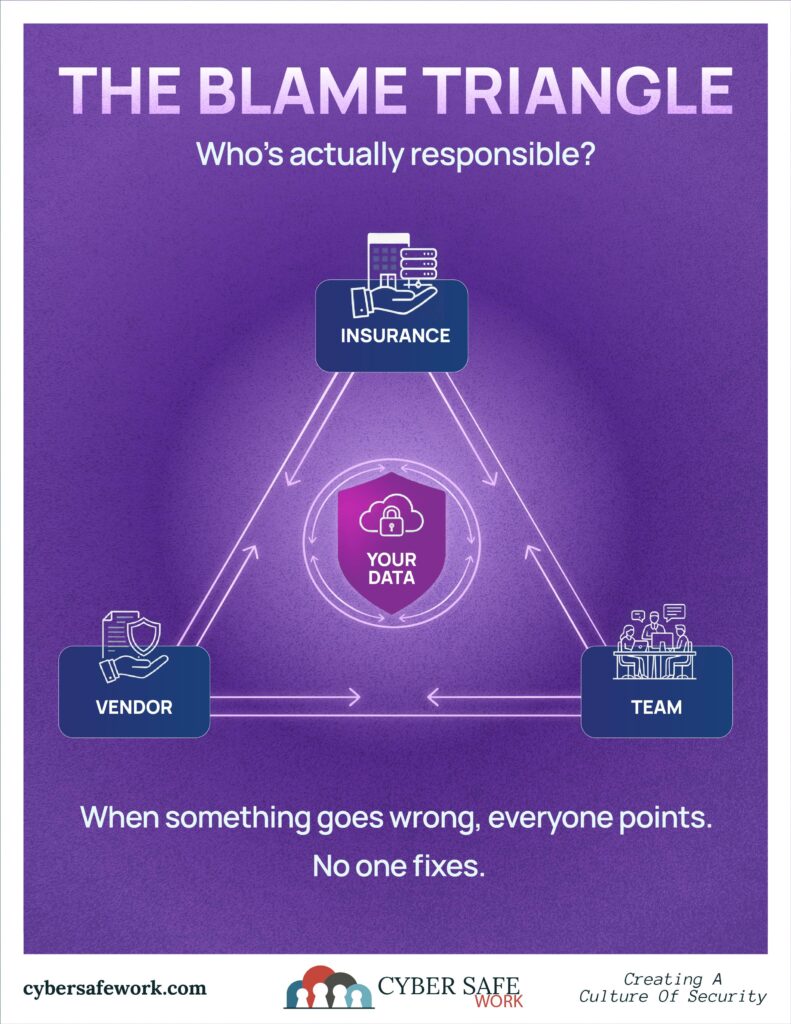
Everyone Thought It Was Covered
When a ransomware attack hits, the finger-pointing starts almost immediately.
The IT provider says the software vendor should have caught it. The software vendor says the organization didn’t follow best practices. The cyber insurance company asks whether required security controls were actually in place. Meanwhile, the organization is left dealing with downtime, recovery costs, public scrutiny, and the question nobody wants to answer:
“Who was responsible for this?”
The uncomfortable reality is that cybersecurity often lives in a gray area of shared responsibility. Businesses, municipalities, nonprofits, and public agencies rely on a mix of internal staff, managed service providers, software vendors, cloud platforms, and cyber insurance policies. Everyone plays a role in security, but many organizations never clearly define who owns what.
That becomes a problem when assumptions replace accountability.
In 2025, a cyber insurer filed a lawsuit against technology vendors hired by one of its policyholders after paying out a ransomware claim. The insurer alleged that the vendors failed to provide security measures and services they had contracted to deliver, contributing to the cyber incident. Rather than simply absorbing the loss, the insurer sought to recover its payout from the organizations responsible for providing cybersecurity services.
Cases like this highlight an important shift in cybersecurity. Cyber insurance is no longer viewed as a blank check that pays for every breach. Insurers are increasingly scrutinizing security controls, vendor relationships, and contractual obligations before and after incidents occur. Organizations are also facing greater pressure to demonstrate that appropriate safeguards were in place and that third-party vendors fulfilled their responsibilities.
The lesson is simple: don’t assume someone else is handling security.
Ask your IT provider what protections they are responsible for. Review vendor contracts to understand security obligations. Verify that critical controls such as multifactor authentication, backups, monitoring, and employee training are actually being performed. Confirm that your cyber insurance requirements align with your current environment.
Most importantly, document who owns each piece of your cybersecurity program.
Because after a breach, everyone has an explanation.
Before a breach, make sure someone has accountability.
Security works best when responsibilities are clear, expectations are documented, and assumptions are eliminated. The organizations that recover most effectively from cyber incidents are often not the ones with the largest budgets. They are the ones that know exactly who is responsible for protecting what.
CourseVector grants permission to use this artwork for any non-commercial purpose as long as the CourseVector contact information remains, as is, on any reproduction or use.
